

I’m not one for New Year’s Resolutions. They are frequently not kept: Typically 25% of people who make a New Year’s resolution will break it by the second Friday of January, affectionately known as “Quitter’s Day”; about 80% will have dropped out by the end of February; and by the end of the year, only 9% of people making resolutions will have kept them1.
But the impulse to look back on the concluding year and ahead to the new one is good, even if resolutions aren’t. So instead of resolutions, here is an activity that you can try, called a start/stop/continue exercise2. It’s simple: Just list some things you don’t currently do but plan to start doing, some things you will stop doing that you currently do, and some things you are currently doing that you will continue to do. Or to make this really focused, which I encourage you to do, list just one thing in each category.
This past weekend I was the passenger on a long car ride to visit family, and I had a chance to do this for 2026. I’m sharing that with you today, along with some special new year’s wishes at the end.
Start: Going analog
In my last post, I wrote a throwaway line in the “Etc”. section that seemed to generate more interest than the post itself:
Lately I’ve been feeling like I spend more time in the digital world than I do in the physical one, and I don’t like it. In 2026 I’d like to have a more embodied existence — thinking and acting with my senses in the physical world. This involves a shift to analog things, like vinyl records and shopping in person, and especially using paper.
During my sabbatical this fall, I was heads-down for 4-5 hours a day doing research, writing, and communicating with faculty doing case studies for my book. I enjoyed it, but by the end of the morning I felt exhausted, not so much from the amount or difficulty of the work, but because all of it was digital, at a screen. The rest of the day, by contrast, usually involved purely physical activities like going for a walk, lifting weights, cleaning the house, and practicing my bass. While it’s hard to compare those two categories, I thought it was interesting that I was more ready for a break after 4 hours of computer activity than I was after 6+ hours of physical activity.
I read two books that I read this fall that clarified what I was experiencing. One was The Anxious Generation by Jonathan Haidt, which lays out in terrifying clarity the connection between the malaise experienced by today’s younger generation (which includes my three kids) and the advent of ubiquitous digital experiences purpose-built to suck them in3. The other was The Extinction of Experience by Christine Rosen, recommended to me by an Intentional Academia reader in the comments on my post. This book addresses the implications of having a disembodied existence via the digital world when in fact, we are humans in physical bodies who need physical experiences to survive and thrive.
Both of these books, together with my unease at digital overload, made me reflect on two things that have great meaning in my life: playing live music with my bands, and being a practicing Catholic. Both of these, while sometimes veering into the digital realm, are fundamentally physical. Playing with a band makes me use my fingers, my ears, my back, my voice. The Catholic Mass involves hearing the songs and bells, watching the priest, smelling the incense. All these are active, full-spectrum sensory experiences that feed my experience of life, not drain it.
Heading into 2026, and the second half of my 50s, I’m wanting more than ever to live with intention and richness. I’m convinced this involves maximizing those sensory, physical experiences. And as I think of practical ways to do that, I keep coming back to the idea of returning to analog, and using digital affordances well but minimally4.
I’ve decided that this includes my systems for productivity. For the last month, I’ve been experimenting with a hybrid analog/digital GTD setup and will be using it in 2026 for as long as it works. It involves:
Using Workflowy, an outlining app, as a back-end database of all my tasks and projects5;
At each weekly review, hand-copying a short list of important tasks to be done during that week into a paper bullet journal notebook; and
Operating day-to-day and moment-to-moment out of the bullet journal, rather than out of a task management app.
I’ve attempted analog systems before, but they broke under the sheer volume of tasks and projects that I face during a semester6. What’s different this time is that I am not planning on using the bullet journal for everything. In particular I am not using it to store and track all tasks and projects. Digital stuff is better for this7. Instead, the weekly review is where I scoop out the subset of tasks that I intend for the week from my database, put them in the notebook, and then leave the database alone until the next weekly review and spend most of my time during a given week outside the weekly review in an analog, paper-and-pen environment.
That’s about all I have to say about this for now, but I plan on giving a lot more details in 2026 once this has a chance to establish itself.
Stop: Extra-long weekly reviews
About those weekly reviews: they’re too long.
I typically do my weekly review on Sunday afternoons. A few weeks ago, I was doing one, and I realized that I was missing a football game on TV that I wanted to see. I looked at the clock and realized I had been at it for an hour already, and was not anywhere near halfway done. The question came up: Why is this weekly review — why is every weekly review — taking so darned long to complete?
I used to allot 60-90 minutes for weekly review, and that was enough. Over the years, the time spent on weekly reviews has crept up to the point where they were taking at least 2 hours and sometimes longer. Now, I am all about being thorough in these reviews, but this is too much. So I audited my process and found I’d broken my cardinal rule of Simplify as much as possible. I found numerous parts of my process I’d read about them somewhere (e.g. articles with titles like “10 Questions You Should Be Asking Yourself Every Week”) and thought they were cool, so I added to the review process without subtracting — ever. My review process was no longer my own review, but an accretion of other people’s ideas about how I should review.
Those add-ons might have added value to the review, but each one came at a time cost that had added up to more than I felt like paying. So I’ve redesigned my weekly reviews around the minimum process that David Allen suggests:
Get clear: Clean up my workspace, get inboxes to zero, clear my head of uncaptured stuff.
Get current: Review next actions lists, the calendar, the Waiting For list, projects, and any other lists I have and get them updated.
Get creative: Review the Someday/Maybe list and note any big creative risks or ideas I might be thinking about.
And for my hybrid system formulation, I also set up the bullet journal for the week: Make a spread with commitments and goals for the week, and loop through my next actions and projects to skim off a subset of tasks that I want to get done this week, hand-copying those into the notebook.
The goal is to complete my weekly review in under an hour8. I did the above process for the first time this Sunday and it took around 75 minutes, which is definitely trending in the right direction. It leaves out a lot of the reflection that I used to do, which did have value. But I figured, this is something better suited for a longer-scope review, like on a per month or per quarter (or trimester) basis. I didn’t feel like I was missing anything by not doing all that high-level review at the end/start of a week; after all, the day-to-day log is right there in my notebook. And I was able to plant myself on the couch and watch football, which perhaps other than going to Mass is my ultimate Sunday goal.
Continue: Actually this is two things
I couldn’t decide on one thing to continue doing because fortunately a lot of what I did in 2025 was successful beyond my expectations, so I’ll share the top two.
First, continue making physical health my top priority for the year. The biggest success I enjoyed in 2025, was losing almost 40 pounds on the Ideal You weight loss program9 during the fall, and going from an lifetime high weight of 212 pounds over the summer to my current weight of around 170. For the first time in a very long time, weight loss is not one of my goals heading into the new year.
Instead, I want to invest effort into building my health through engagement with cardio, weights, and flexibility. I’ve been exercising fairly regularly for a while. But now, many activities will be a lot easier now that I have shed so much excess weight. Physical health is one of those Pareto principle concepts — one of the 20% of things that we do that makes the other 80% easier and better. I’d encourage every higher ed person reading this to consider joining me.
Second, I want to continue in some way to keep the schedule I had during sabbatical. I would trundle out of bed around 6:00am, get coffee, play Wordle, and read The Economist. Then by 7:30 I was at the computer writing or researching, heads down with no interruptions until 11:30 or noon. Then I would just…stop working. The rest of the day was for whatever I felt like doing or needed doing — usually a combo of bass practice, exercise, writing, or low-priority “work” tasks. But I abided by the scientific fact that most people can do no more than 4 hours of deep work per day. We academics may think we’re exceptions to the rule, but it’s only because those 4 hours of useful attention are split up into 100 small shards of attention spread over 8 or more hours. You can combine all those together into a single 4-hour sprint and get the same amount and quality of stuff done, if not more, if the schedule permits.
That last part — permission of schedule — is the rub. A typical academic workday doesn’t allow it. But I’m going to experiment with making it happen somehow anyway next semester when I’m back. At the very least, I only teach on Monday/Wednesday/Friday next term and I have no standing commitments on Tuesday or Thursday, so Tuesday/Thursdays are going to be “sabbatical schedule” days — which means I need to get ready to say “no” to meeting requests and the like on those days, at least in the mornings.
Conclusion for the year
First of all, I’d love to hear your start/stop/continue plans in the comments. You might spark inspiration in one of your colleagues – or get the inspiration you need!
Second, I want to express how grateful I am for each person who reads this blog. Here, I post ideas that are in my mind about life and how to live it well in academia — ideas I’ve always had, but not had an audience until this blog. Attention is scarce and it means a lot to me that you are spending some of it here.
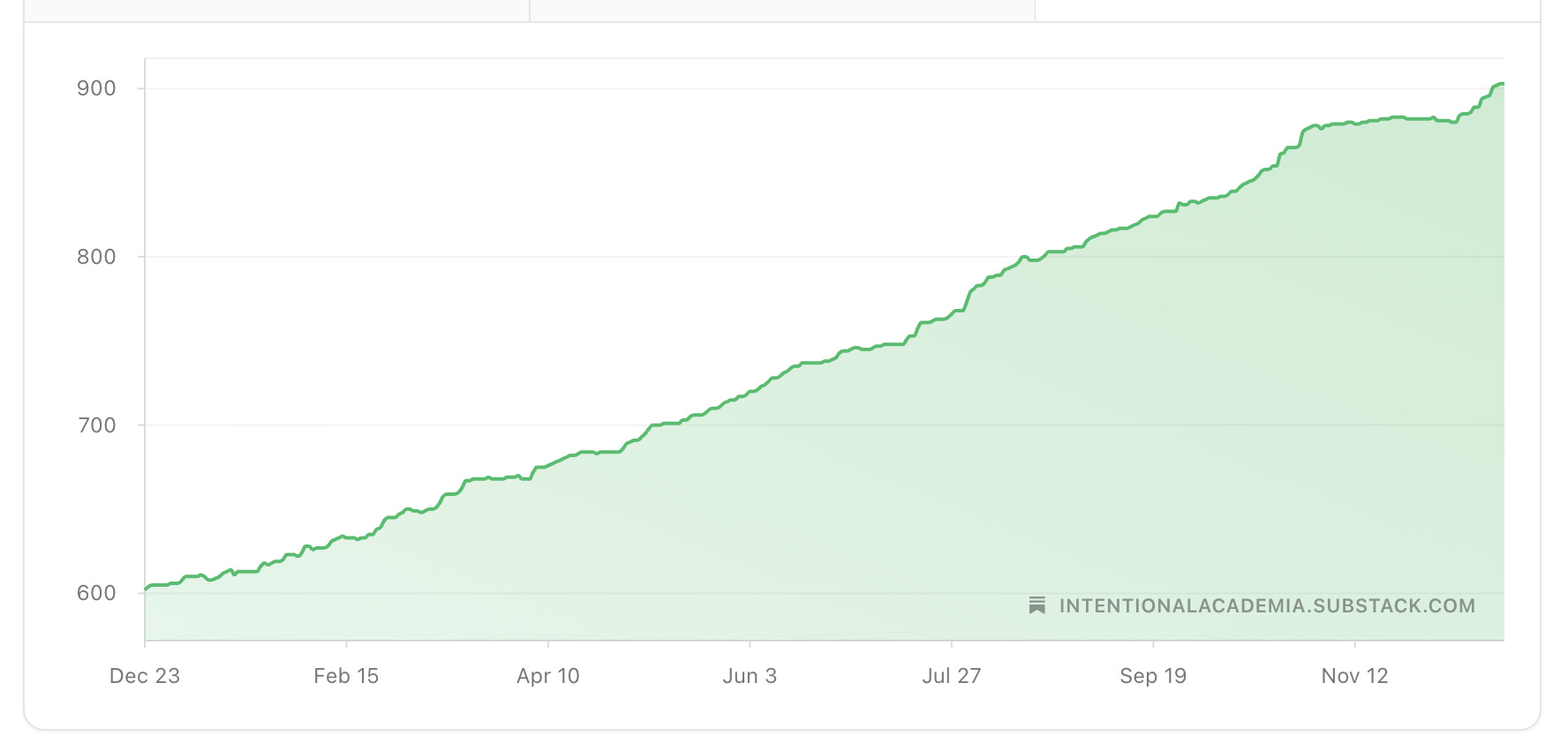
One of my goals for 2025 was to increase readership (measured by the number of subscribers) by 50% over 2024. I am really pleased to say that as of this writing, we’ve gone from 602 subscribers to 903 — almost exactly 50% growth. We did it!
In 2026, you’ll continue to get my best thoughts about productivity and purpose in academia, every other week. Some of the posts I have planned include:
A new series on “10 Ways to Use ____ in Academia” where I focus on simple, usually free tools that can help us do our work, or live life, better – that often get overlooked.
An update or postmortem, depending on how it turns out, of the analog/digital hybrid GTD system I mentioned.
Articles on how to navigate tricky ethical issues that come up here — for example saying “no” when you’re in a vulnerable job position, or why it’s actually OK to not be available to others.
How to build and teach a minimalist course.
Quarterly Q&A posts from readers.
And more!
This Substack is, and I plan on it remaining, free of charge — because I want the message and ideas contained here to spread as far and wide as possible. However, I will point out that there is a paid “patron” subscription available.
For $5 a month or $50 per year, you can help support my writing and make it easier to get these ideas out. You can also give gift subscriptions. There are a few patron subscribers, and the funds from those subscriptions goes to pay for operating expenses10. So paid subscriptions are very much appreciated. But please know I think you are an amazing person regardless whether you pay for all this or not. .
Thanks again and I’ll see you in 2026!
I can’t claim credit for this; it’s a pretty common thing to see in academia and the corporate world.
I was reading this book, ironically on the Kindle app on my phone, back in October on a long bus ride between Athens and Atlanta, GA. I was tempted to ask the driver to pull over, so I could step out of the bus and chuck my smartphone into the woods.
Books are an exception. I love physical books and bookstores, but I find I am simply more likely to read books if they’re on Kindle: Being able to adjust the font size is great for my 55-year old eyes, and in spare moments I can pull out my phone and read a page or two. And Readwise syncs my Kindle notes to Obsidian, making it more likely I’ll take notes and thereby read with more intention and depth.
Longtime readers will have some questions here: Aren’t you a ToDoist guy? Why not use it? Why Workflowy and not, say, Notion or Obsidian Tasks or just a text file? I’ve got my reasons and I plan on writing about those in a couple of months, after this system has had a chance to settle in.
So. Much. Hand-copying.
I dream one day of having a life simple enough that it can all be tracked in a paper notebook.
Getting my inboxes to zero takes much less than an hour because I keep them close to zero at all times. For more on this, see this post.
Briefly, the program involves very strong restrictions on what, when, and how much you eat — it comes out to about 600 calories a day — plus a battery of supplements and weekly coaching sessions. This continues for six weeks, followed by a three-week phase where you maintain the weight you hit after the initial six-week “lose phase”. It is not for the faint of heart but it unequivocally works.
For example, I have a Google Workspace set aside solely for my writing, speaking, and coaching services. It costs me a couple of hundred bucks a year and is worth every penny to have a dedicated digital space, apart from my personal and job spaces. There’s also web hosting and domain name hosting for rtalbert.org, and a few other things.
I always enjoy your reflective write ups on the systems and processes you employ in your professional and personal life and how they change as your life changes.
The part about reviewing long-term stuff less regularly reminded me of something Cal Newport said recently on his podcast, something to the effect of having a system in which tomorrow doesn’t matter but next month does. That long-term and value-based planning is a shield against the latest and loudest. Merry Christmas.